
COR2407 Italian

In this post, I’ll be focusing on the module Italian. I have created an interactive learning platform for this module below. Feel free to play around with it while learning a new language!
Disclaimer: This post reflects my personal experience with the module during the term from August to December 2024, as taught by this specific professor.
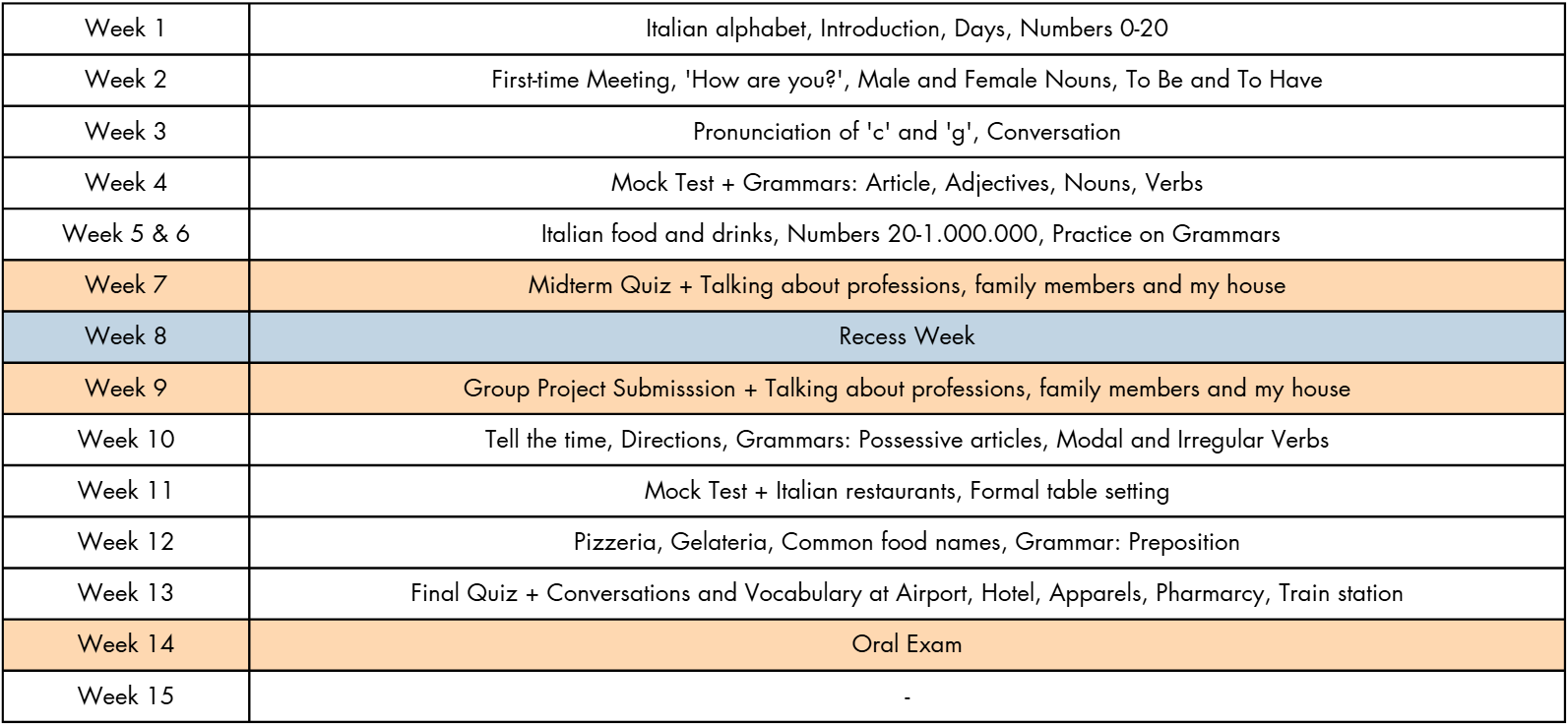
Timeline
📐 Grammatica — Foundation Rules
Start here. Understanding articles, adjectives, and verb patterns forms the backbone of everything else.
| Article | Use | Example |
|---|---|---|
| il | Masc. sing. (most) | il libro |
| lo | Masc. sing. (s+cons, z, gn, ps) | lo zaino |
| l' | Masc./Fem. sing. before vowel | l'orologio |
| la | Fem. sing. | la penna |
| i | Masc. plural (most) | i libri |
| gli | Masc. plural (lo words + vowel) | gli zaini |
| le | Fem. plural | le penne |
| Article | Use | Example |
|---|---|---|
| un | Masc. sing. (most) | un libro |
| uno | Masc. sing. (s+cons, z, gn) | uno zaino |
| un' | Fem. sing. before vowel | un'amica |
| una | Fem. sing. (consonant) | una penna |
| Ending | Gender | Plural |
|---|---|---|
| -o | Usually masculine | → -i |
| -a | Usually feminine | → -e |
| -e | Either gender | → -i |
| -ione | Feminine | → -ioni |
| -ma | Masculine (Greek) | → -mi |
| -ista | Both genders | → -isti / -iste |
| Masc. Sing. | Fem. Sing. | Masc. Pl. | Fem. Pl. | |
|---|---|---|---|---|
| -o adj | bello | bella | belli | belle |
| -e adj | grande | grande | grandi | grandi |
| Pronoun | Meaning |
|---|---|
| io | I |
| tu | you (informal) |
| lui / lei | he / she |
| Lei | you (formal) |
| noi | we |
| voi | you (plural) |
| loro | they |
| io | sono |
| tu | sei |
| lui/lei | è |
| noi | siamo |
| voi | siete |
| loro | sono |
| io | ho |
| tu | hai |
| lui/lei | ha |
| noi | abbiamo |
| voi | avete |
| loro | hanno |
| Verb | Meaning | io / tu / lui |
|---|---|---|
| dovere | must / have to | devo / devi / deve |
| potere | can / be able to | posso / puoi / può |
| volere | want to | voglio / vuoi / vuole |
| sapere | know how to | so / sai / sa |
✦ Mi piace il caffè — I like coffee (sing.)
✦ Mi piacciono i libri — I like books (plur.)
✦ Non mi piace studiare — I don't like studying
✦ Ti piace la musica? — Do you like music?
| Person | Pronoun |
|---|---|
| to me | mi piace |
| to you | ti piace |
| to him/her | gli/le piace |
| to us | ci piace |
| to you all | vi piace |
| to them | piace loro |
| Italian | English |
|---|---|
| Ho fame | I'm hungry |
| Ho sete | I'm thirsty |
| Ho sonno | I'm sleepy |
| Ho caldo / freddo | I'm hot / cold |
| Ho paura | I'm scared |
| Ho fretta | I'm in a hurry |
| Ho ragione / torto | I'm right / wrong |
| Ho voglia di… | I feel like… |
| Ho bisogno di… | I need… |
| Persona | Chiamarsi (I am called) | Chiamare (to call) |
|---|---|---|
| io | mi chiamo | chiamo |
| tu | ti chiami | chiami |
| lui/lei | si chiama | chiama |
| noi | ci chiamiamo | chiamiamo |
| voi | vi chiamate | chiamate |
| loro | si chiamano | chiamano |
Other reflexive verbs: addormentarsi (fall asleep), svegliarsi (wake up), vestirsi (get dressed), divertirsi (have fun), annoiarsi (get bored).
| Word | Singular | Plural | Note |
|---|---|---|---|
| amico/amica | amico / amica | amici / amiche | Hard C kept |
| lago | lago | laghi | Hard G kept |
| uomo | uomo | uomini | Irregular |
| zio | zio | zii | Double -i |
| figlio | figlio | figli | Drop one -i |
| spiaggia | spiaggia | spiagge | Drop one -i |
| paio | paio (m) | paia (f) | Changes gender |
| uovo | uovo (m) | uova (f) | Changes gender |
| mano | mano (f) | mani | Fem. ending in -o |
| Paese | Maschile | Femminile |
|---|---|---|
| Italia | italiano | italiana |
| Singapore | singaporiano | singaporiana |
| Indonesia | indonesiano | indonesiana |
| India | indiano | indiana |
| Corea | coreano | coreana |
| Spagna | spagnolo | spagnola |
| America | americano | americana |
| Cina | cinese | cinese |
| Giappone | giapponese | giapponese |
| Malesia | malese | malese |
| Tailandia | tailandese | tailandese |
| Francia | francese | francese |
| Inghilterra | inglese | inglese |
| Vietnam | vietnamita | vietnamita |
| Combo | Sound | Examples |
|---|---|---|
| ca / co / cu | hard K | caffè, cosa, cucina |
| che / chi | hard K | che, Chiara, cappuccino |
| cia / ce / ci | CH (church) | ciao, cinema, bicicletta |
| ga / go / gu | hard G | gatto, gomma, gusto |
| ghe / ghi | hard G | spaghetti, ghiaccio |
| gia / ge / gi | J sound | giallo, gelato, giorno |
| gli | "million Y" | famiglia, coniglio |
| gn | "canyon NY" | gnomo, Bologna, lasagna |
| sc + e/i | SH sound | scena, uscire, sciarpa |
| sc + a/o/u | SK sound | scala, scuola, scarpa |
✦ Io amo fare fotografie / Mi piace fare fotografie
✦ Io amo uscire con gli amici
✦ Io amo giocare a tennis / a basket / ai videogiochi
✦ Io amo praticare yoga e Pilates
✦ Io amo cucinare cibo giapponese / cinese / italiano
✦ Io amo suonare: il pianoforte · la chitarra · il violino · la batteria
✦ Mi piace guardare film romantici / thriller / commedie
✦ Mi piace leggere libri / manga / fumetti / webtoon
✦ Mi piace ascoltare musica pop / jazz / hip hop / classica
✦ Sapere = knowledge of facts, information, or ability to do something
✦ Conoscere = acquaintance/familiarity with a person, place or thing
| Sapere (facts / abilities) | Conoscere (people / places) |
|---|---|
| Non lo so — I don't know it | Conosci Luca? — Do you know Luca? |
| Non so cucinare — I can't cook | Conosco Tokyo! — I know Tokyo (familiar with it) |
| Sai sciare? — Can you ski? | Non conosco questo dramma — I don't know this drama |
| So parlare italiano — I can speak Italian | Conosco bene Singapore — I know Singapore well |
| Sappiamo la risposta — We know the answer | Voglio conoscere nuovi amici — I want to meet new friends |
Non c'è = there is no / there isn't · Non ci sono = there are no
| C'è (singular) | Ci sono (plural) |
|---|---|
| C'è un ristorante — There is a restaurant | Ci sono tanti ristoranti — There are many restaurants |
| C'è un lago bello — There is a beautiful lake | Ci sono tanti negozi — There are many shops |
| C'è la palestra? — Is there a gym? | Ci sono musei famosi? — Are there famous museums? |
| C'è anche la piscina! — There is a pool too! | Ci sono tanti grattacieli — There are many skyscrapers |
| Singolare | Plurale |
|---|---|
| il mio | i miei |
| il tuo | i tuoi |
| il suo (his/her) | i suoi |
| il nostro | i nostri |
| il vostro | i vostri |
| il loro | i loro |
| Singolare | Plurale |
|---|---|
| la mia | le mie |
| la tua | le tue |
| la sua | le sue |
| la nostra | le nostre |
| la vostra | le vostre |
| la loro | le loro |
il mio libro / la mia borsa / i miei libri / le mie borse
⚠️ With family members (singular): NO article!
✓ mio padre, tua madre, sua sorella, nostro zio
✗ il mio padre — NEVER!
Exception: loro always takes the article: il loro nonno, la loro madre
And plurals always take the article: i miei nonni, le tue sorelle
Preposizioni composte: di, a, da, in, su combine with the article.
| Prep | + il | + lo | + la | + l' | + i | + gli | + le |
|---|---|---|---|---|---|---|---|
| di | del | dello | della | dell' | dei | degli | delle |
| a | al | allo | alla | all' | ai | agli | alle |
| da | dal | dallo | dalla | dall' | dai | dagli | dalle |
| in | nel | nello | nella | nell' | nei | negli | nelle |
| su | sul | sullo | sulla | sull' | sui | sugli | sulle |
💡 Città e paesi: a Firenze, a Singapore, a Tokyo · in Italia, in Giappone, in Vietnam
💡 Luoghi: a scuola, a casa, a letto, al cinema, al bar, al mare, all'università, alla stazione, in centro, in biblioteca, in farmacia, in chiesa, in palestra, in aeroporto
💡 Verbi con "a": vado a mangiare, vado a studiare, vado a fare jogging, vado a nuotare, vado a ballare
💡 Persone con "da": dal dottore, dalla professoressa, dallo psicologo, dall'avvocato
| attore | → attrice |
| pittore | → pittrice |
| scrittore | → scrittrice |
| scultore | → scultrice |
| imprenditore | → imprenditrice |
| professore | → professoressa |
| dottore | → dottoressa |
| studente | → studentessa |
| impiegato | → impiegata |
| poliziotto | → poliziotta |
| commesso | → commessa |
| parrucchiere | → parrucchiera |
| infermiere | → infermiera |
| cameriere | → cameriera |
| cantante/i | singer |
| insegnante/i | teacher |
| dirigente/i | executive/CEO |
| stilista/e | stylist/designer |
| dentista/e | dentist |
| farmacista/e | pharmacist |
| barista/e | barista |
| regista/e | movie director |
| avvocato/i | lawyer |
| ingegnere/i | engineer |
| architetto/i | architect |
| medico/i | medical doctor |
| Italiano | English |
|---|---|
| il marito | husband |
| la moglie | wife |
| il padre / il papà | father / dad |
| la madre / la mamma | mother / mom |
| il fratello maggiore | older brother |
| la sorella minore | younger sister |
| il nonno / la nonna | grandfather / grandmother |
| lo zio / la zia | uncle / aunt |
| il cugino / la cugina | cousin (m/f) |
| il nipote / la nipote | grandchild / niece / nephew |
| Italiano | English |
|---|---|
| il cognato | brother-in-law |
| la cognata | sister-in-law |
| il suocero | father-in-law |
| la suocera | mother-in-law |
| il patrigno | step-father |
| la matrigna | step-mother |
| i genitori | parents |
| figlio unico / figlia unica | only child (m/f) |
| la casalinga | housewife |
| è in pensione | is retired |
Studio italiano da due mesi = I have been studying Italian for two months (still ongoing)
Ho studiato francese per quattro anni = I studied French for four years (finished)
📖 Vocabolario — Weekly Words
Browse all vocabulary by week. Each word shows its article, Italian, and English meaning.
🔤 I Verbi
Click any verb to reveal its full conjugation table. Use the search to filter.
🃏 Flashcards Vocabolario
Click the card to flip · Use arrows or keyboard shortcuts to navigate.
✏️ Fill in the Blank
Type the Italian word from the English prompt — press Enter or Tab to check each answer.
💬 Domande e Risposte
Common Italian conversation questions. Read the question aloud, form your own answer, then reveal the model response. These are personalised to help you introduce yourself in Italian.
🍕 La Cultura Italiana
Click any card to reveal the answer. Test your knowledge of Italian customs, history, and food culture.
Instructor's Dynamic
Professor Francesca is such an engaging professor who makes learning a new language easier and more fun. Maybe it’s true that Italians are more extroverted and expressive. Every lesson felt like an energized lecture.
In terms of assessments, some components are tricky (e.g., the grammar part), but the listening and vocabulary sections are manageable. All of the assessments are conducted during the term, so it doesn’t add to the stress during exam week. However, because of that, last-minute studying does not work very well, since students also have many other activities ongoing during the term. Hence, the best advice is to study a little every week. The content is not a lot each week, but it will quickly pile up if it goes unnoticed.
To sum up, learning Italian was a pretty fun experience, and although I don’t remember all the grammar and vocabulary after the exams, I would highly recommend it to those who want to clear the Culture basket.
That's all! I hope you enjoyed my summary of the Italian module. Once again, this is based on my personal experience. As Heraclitus wisely said, "The only constant in life is change," so the curriculum might have already evolved by the time you read this. Please take this as a guide, not a definitive account!