
FasTrack Internship (Audit) @ Deloitte
This post outlines what a realistic and personal FasTrack audit internship at Deloitte look like :D

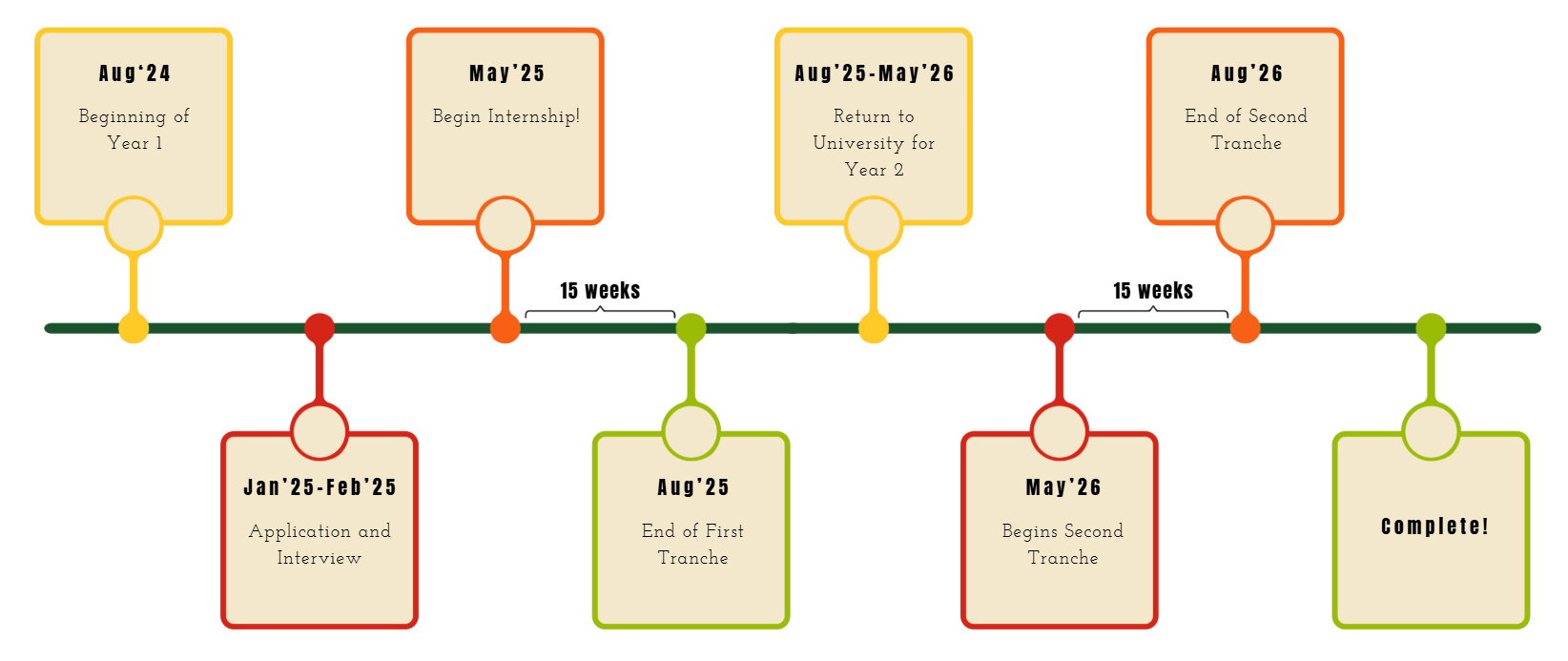
Entering Deloitte as my first university internship was something that I had looked forward to, and honestly, it was a long experience stretched over 30 weeks, split into two summers. In this blog post, I’ll be listing out my internship experiences at Deloitte and summarizing some key takeaways.
Timeline
The Beginning
First Tranche
One week prior to the internship, all new interns received onboarding details. The jittery feeling of waiting for the internship, coupled with endless imagination about the work environment, made the waiting process an almost unbearable one. Regardless of the butterflies in my stomach, the first week arrived and we were greeted by the IT and Talent team on the first day. Sitting around tables of interns who most likely came from the same background in Accountancy, we introduced ourselves to each other and the atmosphere eased a little. Each of us obtained a work laptop and our ID card. With the orientation on company culture and an info session on the Audit & Assurance business unit, the first day ended fairly quickly. We were all instructed to complete a series of online trainings for the week. The trainings mainly introduced us to the audit procedures practiced at Deloitte, some Excel analytics, US GAAP and IFRS guidance, and the cloud-based platforms used for work purposes (namely Omnia and Levvia).
To digress slightly on why this internship stretched to 30 weeks: I initially only joined as a summer intern working for 14 weeks. However, during orientation, I was informed by the Talent team that we could apply and convert to the FasTrack programme if interested. After consulting my senior and the Talent team on the possibility, I decided to join the FasTrack programme. To keep it short, I’ve summarized the reasoning into the following table:
- Pros:
- Higher chance of obtaining a priority offer for a permanent position after graduation
- If I split the internship into two phases of 15 weeks, I can complete the internship in two summers (e.g. Y1 and Y2 summer)
- Secure internship for two summers
- Cons
- Potential opportunity loss: Some people would say it takes too long to try out an internship, as normally a student would only have 3 summer breaks before entering the workforce, and if 2 summer breaks are already spent on 1 single internship, it would be deemed to have missed out on other opportunities.
Personally, I have strong interests in pursuing an audit career upon graduation, and I am fond of having a stable career after graduation. Therefore, it was not a hard decision to join the FasTrack programme.
My First Engagement
After completing the required trainings, which lasted around a week, I was introduced to my first engagement in the investment holdings industry. It was a rather moderate-to-large-sized team consisting of 7-10 active working auditors. I was lucky to be in a supportive team which, despite the busy period, was willing to teach me how things work, ranging from client data processing to the preparation of working papers. I still vaguely remember the first meeting with my assistant manager over Teams — I was frantically writing down everything he said regarding the company information and the work we needed to do. Following that meeting was an online group meeting with the whole team to follow up on the progress of the audit work. The atmosphere was rather casual, but there was a clear agenda to ensure everything was on track for the team.
Initially, I was tasked with rather administrative work, like removing passwords from past-year financial statements, preparing minutes-related working papers, and cross-referencing between working papers and the financial statements. However, despite being easy tasks, they introduced me to the Omnia platform and PDF-Xchange Editor. As it was a rather big engagement with many subsidiaries, it was common to use abbreviations for naming purposes, and I confused myself a lot with the similar names (e.g. the parent company named XXX-Holding, with subsidiaries named XXX-I and XXX-II; or trying to distinguish between III XX II vs III XX vs II XX). After a while, I was tasked to clear archival points, do journal entry testing, and fill up some leadsheets.
Going to the client’s office for the first time was also quite exciting. Besides the fact that the office was nicely located with city-central views, it was also the first time I met the whole engagement team in person. One partner, three managers, one assistant manager, one senior, and one intern (me) went to the client office, and to be frank, it was a nerve-wracking experience — the first time being in a room with the client sitting opposite us, and me, a newbie staring at my computer not knowing what to do, feeling almost like a wild animal that had wandered into a supermarket, lost as to its purpose. However, the subsequent team lunch was quite amicable and remains the best team-lunch experience I’ve had thus far.
There were two key challenges I faced in this engagement. First, I was not familiar with the workflow and how exactly an audit should be conducted. The fact that I had not taken the audit module in school was the main reason I was constantly confused about why certain audit procedures needed to be performed. Despite the explanations from my seniors, I’ll admit that I did not fully understand the purpose of some procedures. Secondly — and this is in retrospect — my accounting knowledge at the time was clearly lacking. Having only taken Financial Accounting and Management Accounting in Year 1, I only had the basic knowledge of what accounting consists of, and the financial instruments in the investment holding industry were honestly not typically taught to Year 1 students. For example, I only learnt about impairment of financial instruments in the Intermediate Financial Accounting module in Year 2 Semester 2. Therefore, throughout the engagement, I could only follow the prior-year workings mindlessly without really understanding what each procedure was meant to achieve.
Despite the difficulty in understanding, I requested to extend my booking on the engagement due to the supportive working environment and my belief that I would learn much more if I continued to stay on the same engagement. (Side note: interns are usually rotated between engagements to “expose them to different industries.”)
Second Engagement
After working on the same engagement for 4-5 weeks, I was assigned to another engagement in the wholesale trade industry. The transactions were rather straightforward, and it was in this engagement that I really did vouching for revenue and expenditure. There was a contrast in the audit procedures performed due to the difference in the nature of the businesses.
This engagement was rather small, mainly due to the separation of work across different subsidiaries, and I only worked with one senior for this branch. As the company follows a June year-end, I was booked for both interim and final. The interim week was quite simple, as it mainly consisted of preparing leadsheets for finals and performing some test-of-details procedures for the profit & loss line items. After one week of interim, I returned to my first engagement for another 3 weeks before coming back to this engagement for the final.
One highlight from this engagement was my first stock take on a Saturday. From selecting samples to walking around the two-storey warehouses counting inventory, while the warehouse staff showed us how the operation worked, from their tagging system to their sheer familiarity with the stock. It was a genuinely new and fun experience, and a reminder that audit work isn’t confined to a desk.
Third Engagement
As I returned from the second engagement back to the first, the entire engagement was near the archival stage, and I had little on my plate. Hence, my manager assigned me to another engagement that planted the seed for my next tranche. I was assigned to this engagement to clear review notes and vouch for samples that had not been completed by previous staff. As it was a non-profit organization that mainly relied on donations and grants for income, it functioned differently from a normal profit-driven organization in terms of revenue, and the audit procedures were hence different.
Although I did not do much during the week I was on the engagement, spending most of my time trying to figure out how the accounts worked, it was a new experience with a lot to learn. In the meantime, I was also asked by my previous senior to help with archival for that job. This made me realize that it is quite common to handle several engagements at the same time, even at the preparer level.
Ending of First Tranche
My first 15 weeks at Deloitte ended with me helping the same manager on her other engagements, followed by the start of my Year 2 school term.
Beginning
of Second Tranche
Coming back for tranche two felt different before it even started. I’d gone through a full semester of school with the audit module and more accounting under my belt, and I was curious whether that would actually translate into feeling more capable on the ground, or whether I’d be starting from scratch all over again. As it turned out, it was the former, though not without its own complications.
The onboarding itself was familiar: a new laptop and ID, sitting among interns from similar backgrounds, heading up to the Audit & Assurance floor — all déjà vu, except the online trainings were far shorter this time, taking only 2-3 days instead of a full week.
First Engagement
(The Longest I had)
Remember the engagement with the non-profit organization? I was assigned to it again – this time for the full 15 weeks. I have a strong feeling my prior manager arranged this deliberately, since she was once again the recurring manager on the job.
The team was lean: one partner, one manager, one assistant manager (AM), and me. I felt uneasy at first, since there would be weeks where I’d be working with no other senior on the job at all. After working a few days on the engagement, the manager informed us that she would be handing it over to another manager who, to our knowledge, also did not have ample experience in the industry.
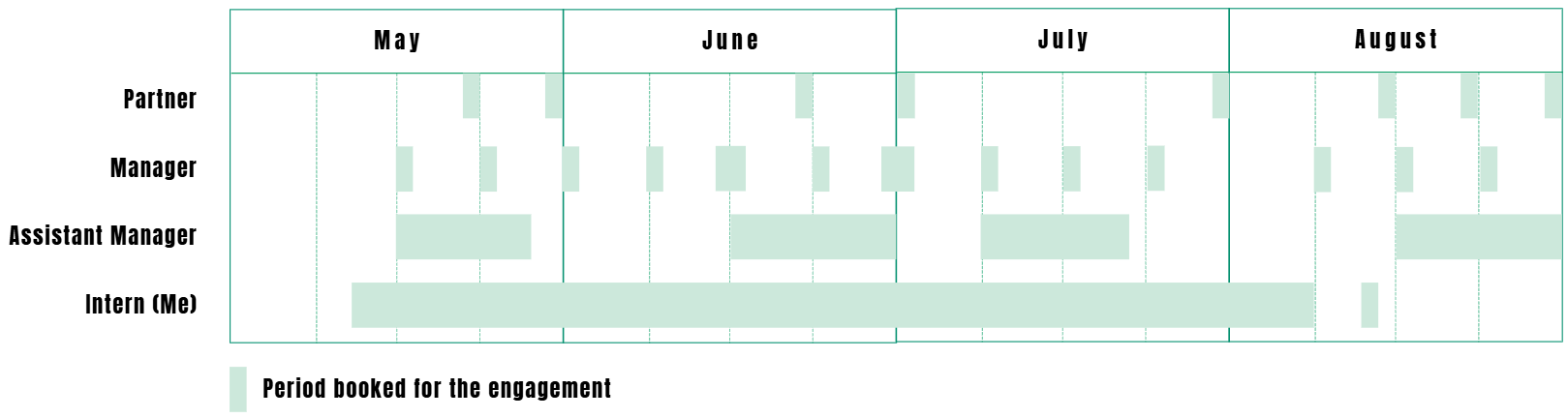
It was worrying, but the work went on regardless. My first few weeks were spent cleaning the general ledgers and reviewing prior working papers, before heading to the client’s office with my AM. We were greeted by the same finance team as before, and things moved smoothly from there. Whether it was the “returning intern” effect or simply having more coursework behind me, I noticed a real shift: I asked more questions about things I didn’t understand, and for the first time, I actually understood why I was asking them, which was a direct contrast to the first tranche, where I’d often followed procedures without grasping their purpose. This was also the first engagement I worked from start to finish. I clarified queries directly with the client with much more confidence, encouraged by my AM to do so, and even handled tasks like mailing bank confirmations and sending accounts payable confirmation requests to suppliers — tasks I wasn’t sure were typical this late into an internship.
Since my AM wasn’t on the engagement full-time, I ended up working alone for a couple of weeks. That autonomy was new territory. Instead of constantly asking for work, I knew what needed to be done and just did it, only reaching out to my AM when I genuinely needed clarification. I prepared working papers for revenue (donations and grants), operating expenditure, accounts payable and receivable, intercompany balances, PPE, and equity (general and specific funds) — a much bigger scope than anything I’d handled before.
Luckily, the work needed minimal corrections once my AM reviewed it. When we regrouped at the client’s office, the manager told us we’d also need to handle work beyond the standard statutory audit. For simple visualization:
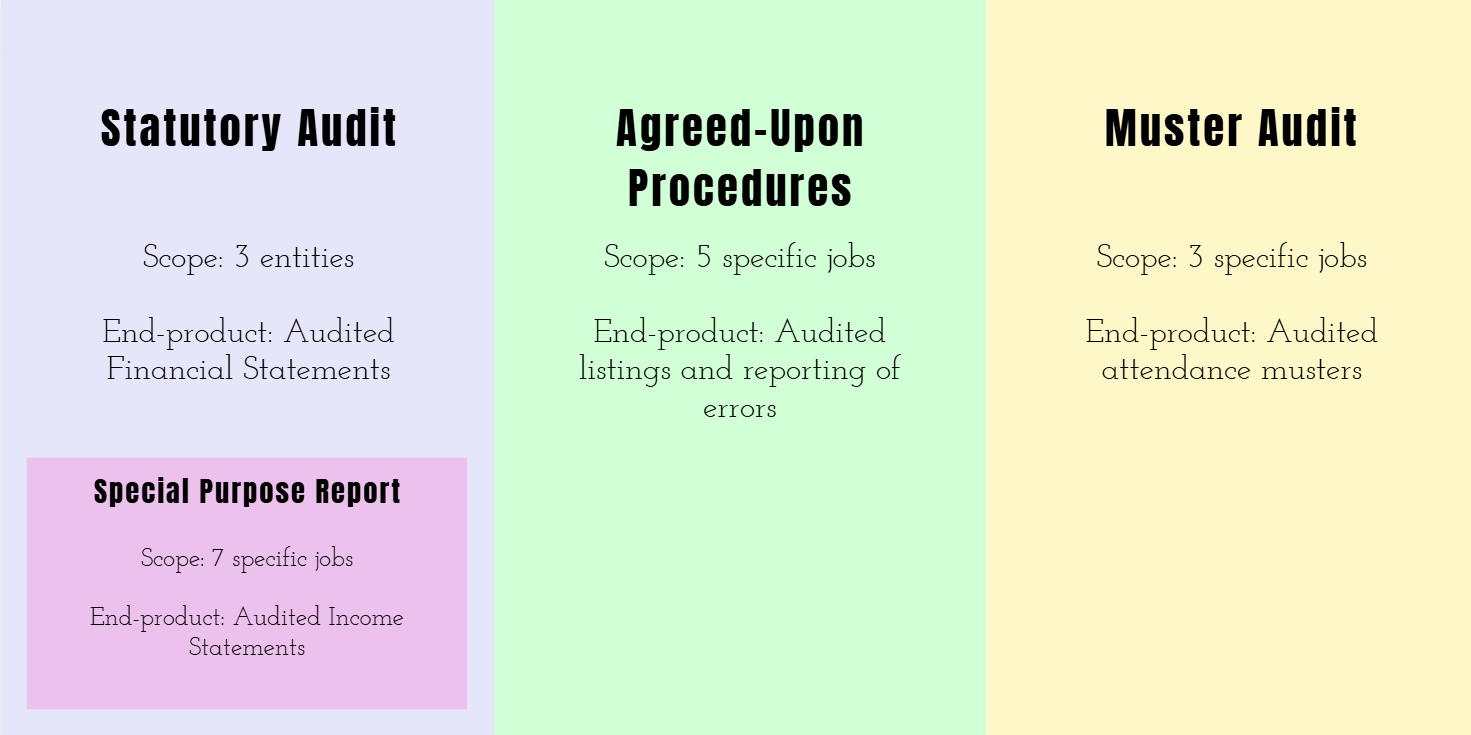
Since neither of us had done these before, we started with the one involving numbers: the special purpose audit. From there we moved to the AUP and muster audit, which involved far more reading than I expected as I familiarized myself with the terms of reference. Without getting too technical, I’d summarize AUP as performing procedures required by the client of the organization we are auditing (in this case, the government providing subsidies to the NPO), and the Muster audit as verifying the controls for tracking the presence and attendance of personnel.
Second Engagement
Alongside my main assignment, I helped my manager with another engagement in the hospitality industry that was nearing its closing stage. I didn’t do a huge amount that week, as I mostly work on subsequent events review and cleaning up working papers.
One highlight was comparing the client’s consolidated financial statements against what the engagement team had. With one holding company and nine subsidiaries, mapping account codes to the right financial statement lines took real patience, and I picked up some useful Excel techniques along the way for visualizing the comparisons and discrepancies.
Final Note
Looking back across both tranches, the 30 weeks weren’t always busy, but they were consistently fruitful. Part of that came down to timing: my internship always fell in the May-August window, which isn’t the “peak period” audit is known for, since most companies follow a December year-end. This means staff often juggle several engagements at once rather than being buried under one during the "peak period", while rushing for deadlines.
There were plenty of warnings from existing staff that an audit career means endless overtime. But as Deloitte Audit Leader Yang Chi Chih put it during our interns get-together session, “work-life balance is different for everyone.” For me, an audit career, despite its reputation for being tiring and low-paying at entry level, offers a clear and transparent career ladder that I genuinely value. If I had to sum up what changed most between my first and second tranche, it’s this: I went from mindlessly following prior-year workings to actually understanding why I was doing what I was doing. Overall, this internship served rightfully as good experience and preparation for me to join the industry upon graduation.
Other Activities
Throughout the internship, I have attended several events such as Family Day, Interns Get-Together and A&A Connect.
Family Day: Big Bash 2026

Family Day is Deloitte's carnival-style tradition, a casual outdoor event for staff, plus a family member or friend, to enjoy together. I attended with a friend from my internship, and the most memorable parts of the day were, hands down, the food and the watercolour face painting. I'm still salivating just thinking about the mashed potatoes and meatballs from the event. Highly recommend attending if any intern get the chance.
Interns Get-Together
Held in a work day afternoon, this event aimed to connect interns with partners and managers as they share their journeys and stories. Personally, I found the information shared quite useful, as it allowed us to picture realistic career paths for auditors.
A&A Connect

Inviting roughly 1,800 auditors from the firm, this event gathered the business unit to make a firm-wide announcement of the office's relocation, a briefing on ethics practice, and a celebration of the business unit's journey.